

Member Exclusive: Email fatigue got you down? Here's how to perk up your comms
Techniques to maximize your use of the most popular internal communications channel
By Mike Prokopeak, director of learning and council content
Everyone says they want less email, but yet it's their preferred way to receive information.
That's the quandary, shared by a CLC member on a recent Think Tank call, that sums up the challenge facing employees and communicators alike when it comes to their relationship with their inbox.
People have a love-hate relationship with email, but whatever their feelings it remains one of the most important communication channels. According to data from Ragan's 2024 Communications Benchmark Report, email is by far the most effective channel for internal communications, besting the intranet and virtual company meetings by more than 20%.
But that popularity doesn't mean it can't be improved. Here are a few tips on how to perk up your flagging email communications.
Avoid email altogether
Email tends to be the default mode for communication because of its familiarity, ease of use and ubiquity. But it shouldn't always be your go-to. Refining your approach to communications can help cut down on email fatigue.
It's up to communicators to determine the right channel for a particular message. One CLC member published their strategy with a description of which channel is best used for each specific purpose as a way to facilitate decision-making with stakeholders. That has been helpful in shifting communications off email when appropriate.
"Everything does not need to be a CEO message," according to one Think Tank participant.
If stakeholders resist, share sources of data like email open rates . Low engagement can help convince stakeholders to take a different approach.
One caveat: Be careful that publishing channel strategy doesn't give stakeholders the impression that they have a menu from which they can pick and choose their preferences. Retain that consultative mindset and counsel on what channel is best to achieve their objective.
CLC Resource: 2024 Internal Email Benchmark Report
Content: Less is more
When email is the best option, trim down the content. Put yourself in the shoes of the person receiving the message and "send the message you would want to receive," said Jenny DeVaughn, vice president of internal communications at ADP.
DeVaughn, a CLC member, shared tips for how communicators can make better use of email as a communications tool at Ragan's recent Internal Communications Conference at Microsoft's headquarters in Redmond. A good rule of thumb, she said, is to write as if every word costs $1,000. In fact, it may very well be even more costly.
"I know when I send a message to an associate, I'm asking them to stop spending time with a client so it better be worth it," DeVaughn said.
Cutting down on wordy content is one strategy to enhance the success of email. Limiting the number of stories is another. DeVaughn recommended no more than three stories in an employee-facing newsletter, for example.
Given the limited real estate, it's therefore important that the first story in every newsletter hits every mark. It should check all the boxes: engaging, information-rich and hits key themes.
Use storytelling techniques
Beyond brevity, use the power of story to power better email communications. Don't inundate employees with a deluge of facts, figures and frameworks. Instead, use tried-and-true narrative structures to engage them in your messages.
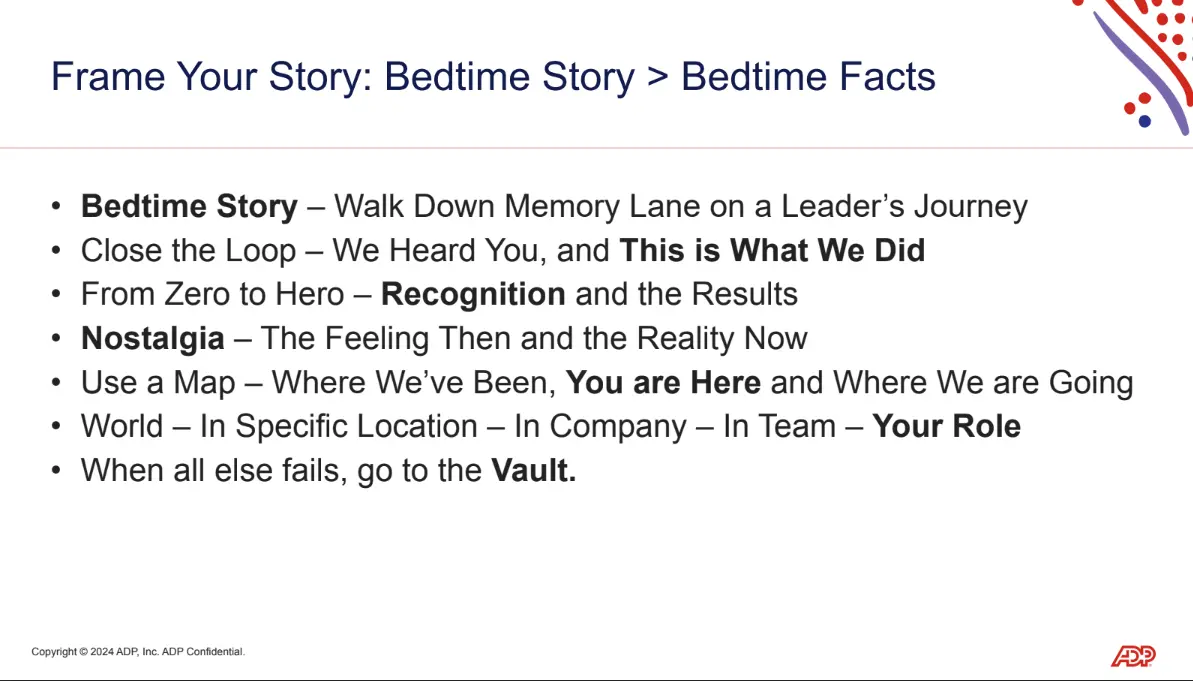
Think of communications like a bedtime story you might tell your kids, DeVaughn said. "Kids don't want bedtime facts, they want a bedtime story," she said.
DeVaughn offered seven ways communicators can frame their email narratives (image below).
They include tips like "close the loop." When you send out an engagement survey, close the loop at the end and share the story that emerged from the data. Employee recognition is another powerful way to frame stories, as is the use of nostalgia.
Location is also useful narrative framing device. Show the company's journey by using a map that illustrates where you've been and where you're going, DeVaughn said. Related to that, spotlight where the individual fits in the global strategy so there's clear connection to their day-to-day work.
Then, when the story well runs dry, go to your vault of story ideas. Have a place where you collect ideas on an ongoing basis and use that to create a database you can turn to in a pinch.
Overcoming email fatigue boils down to being more selective about how you use this powerful communications tool. When you choose to use it, be concise and engaging. But that's not all it takes. DeVaughn counseled communicators to choose accuracy over speed.
“If you send something and the links aren’t working, you are diminishing trust in you," she said.
Ultimately, it comes back to taking a employee-centric view of communications. Think clearly about what employees care about and what messages leaders want to share with them before crafting an email communication.
"You have to be in your associates' shoes all the time and understanding how they feel," DeVaughn said.
Have an email template that works or a practice you'd like to share? We'd love to hear from you. Send me an email at [email protected].