

Member Resource: 2 decision frameworks for engagement in social or political issues
When is the right time to use the corporate voice? Members share how they approach the issue.
By Mike Prokopeak, director of Council learning, community and content, Ragan Communications
When to speak up on a social or political issue has long been a question many companies struggle with. During the second Trump Administration, it's become even more fraught with risk.
Following the fatal shooting of protester and ICU nurse Alex Pretti during federal immigration enforcement actions in Minneapolis last weekend, 60 CEOs issued a joint statement through the Minnesota Chamber of Commerce calling for de-escalation and cooperation across federal, state and local leaders.
The statement, which didn't directly name Pretti, U.S. Border Patrol, Immigration and Customs Enforcement (ICE), President Trump or any of his Cabinet members, demonstrated the balancing act companies are navigating a in highly charged political environment. In this case, the risk of no response outweighed the potential backlash from the President, but the companies issued a carefully worded joint statement to diffuse any blowback.
At Tuesday’s Council Think Tank, members wrestled with the core question: When is it the right moment to use the corporate voice? Whether the issue is social unrest, labor relations, international disputes, tariffs and taxes or a host of public policy issues, the key takeaways are consistent:
- Use a shared decision-making framework to pressure test issues.
- Develop a scorecard to align stakeholders and prioritize a response, if one is needed.
- Focus on meaningful support to those affected over performative statements.
Here are two sample decision-making frameworks members shared for how their organizations approach sensitive issues. Note: These frameworks are not for publication outside the Member portal and are intended for use just by Council members.
Do a basic risk assessment
Matt Lara of member company Edward Jones shared the way he approaches issue engagement on the call. This is not a direct reflection of Edward Jones' internal guide, but rather a collection of insights he has used across companies.
Before engaging publicly on any matter, consider these four essential criteria:
- Is this consistent with our values and what we stand for? (does this align with who we are?)
- Can we add real value, or do we have unique expertise to offer? (do we have a legitimate role in this conversation?)
- Have we listened to the people this affects? (do we understand all the perspectives involved?)
- Is there a real impact on our stakeholders? (does this matter to the people we serve?)
Use your responses to the four questions above to determine your level of engagement:
All four criteria met – proactive engagement
- You are well-positioned to contribute meaningfully. Consider public statements, thought leadership, or active participation in industry dialogue.
2-3 criteria met – selective engagement
- Engagement may be appropriate with careful messaging and clear boundaries. Evaluate the specific context and develop a targeted approach.
1 or fewer criteria met – no engagement
- Without sufficient alignment, capacity, understanding, or relevance, public positioning risks appearing inauthentic or opportunistic. Continue monitoring the issue privately.
Ask key questions in four key areas
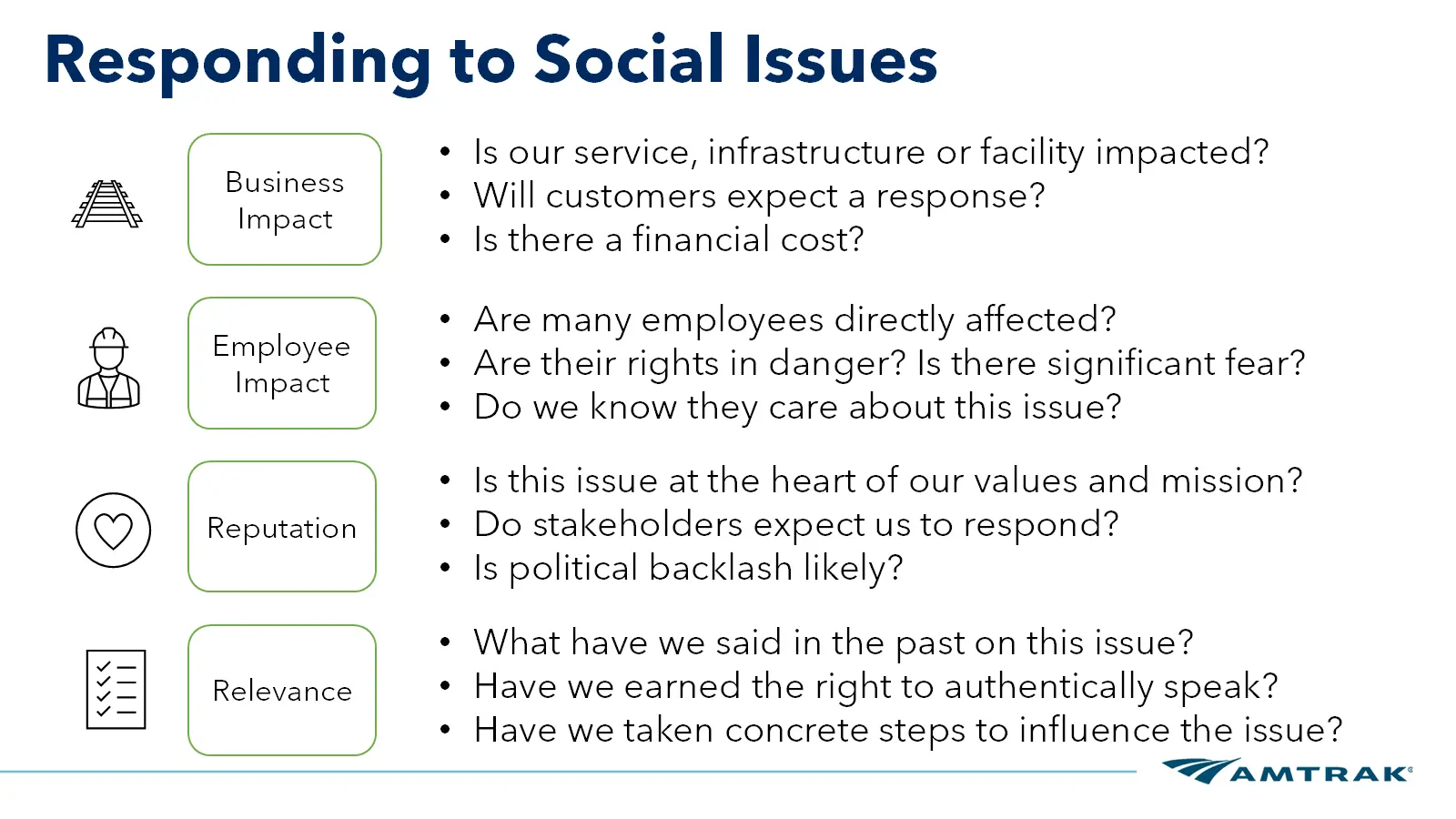
Doug Duvall of Council member Amtrak shared this slide covering the key questions to address in deciding whether or not to engage on social issues.
The four categories of questions include business impact, employee impact, reputation and relevance. Any potential issue should first be pressure tested to determine if the organization should issue a response or statement.
No matter the issue or what the response may or may not be, transparency and authenticity are what matters, both internally and externally.
Authenticity matters more than volume, said one Council member during the Think Tank, so any company action or statement should focus on how to add value, not more noise.
The monthly Think Tank meetings are an exclusive opportunity to network and problem-solve with other Council members while exchanging ideas on relevant communications issues. The next meeting is scheduled for Feb. 24.