
Your company’s stance on social issues could be hurting your recruiting, study shows
Organizations looking to attract a young, diverse workforce should put their actions where their words are on social issues.
By Emma Atkinson

First, it was health insurance and job security. Then, it was ping-pong tables and kombucha on tap. Now, employees want something else from their employers: A commitment to taking public stances on social issues.
Research has shown that employees, especially young ones, want the places they work to reflect and uphold their personal values, which often means speaking out about issues like racism, gun control and reproductive rights.
But some employees feel more strongly than others about the responsibility of companies to speak out, resulting in a notable disparity broken down by race and age.
A new report from JobSage shows that 82% of Gen Z employees want companies to take a stand on social issues, while just 48% of Baby Boomer respondents said the same.

And Black Americans feel more strongly about companies taking a stance on issues than their white and Hispanic counterparts, with 83% of Black respondents saying they’d like to see companies take a stand. Just 62% of white respondents and 59% of Hispanic respondents said the same, with 70% of Asian respondents representing the middle of the pack.
In addition, the report found that nearly a quarter of workers have “declined a job offer or decided not to apply for a role because of a company’s public stance on social issues,” while 27% of respondents said they’d take a pay cut of over $5,000 to work at a company that takes a public stance on social issues.
While these numbers may seem like nothing new to communicators, it’s yet another reminder of the power of social issues in your employer branding strategy. By not taking a strong public stance on social issues, you may be opening your organization up to a hiring crisis — the data definitively shows that employees want to see more from their employers in terms of these issues, along with ESG and DE&I commitments.
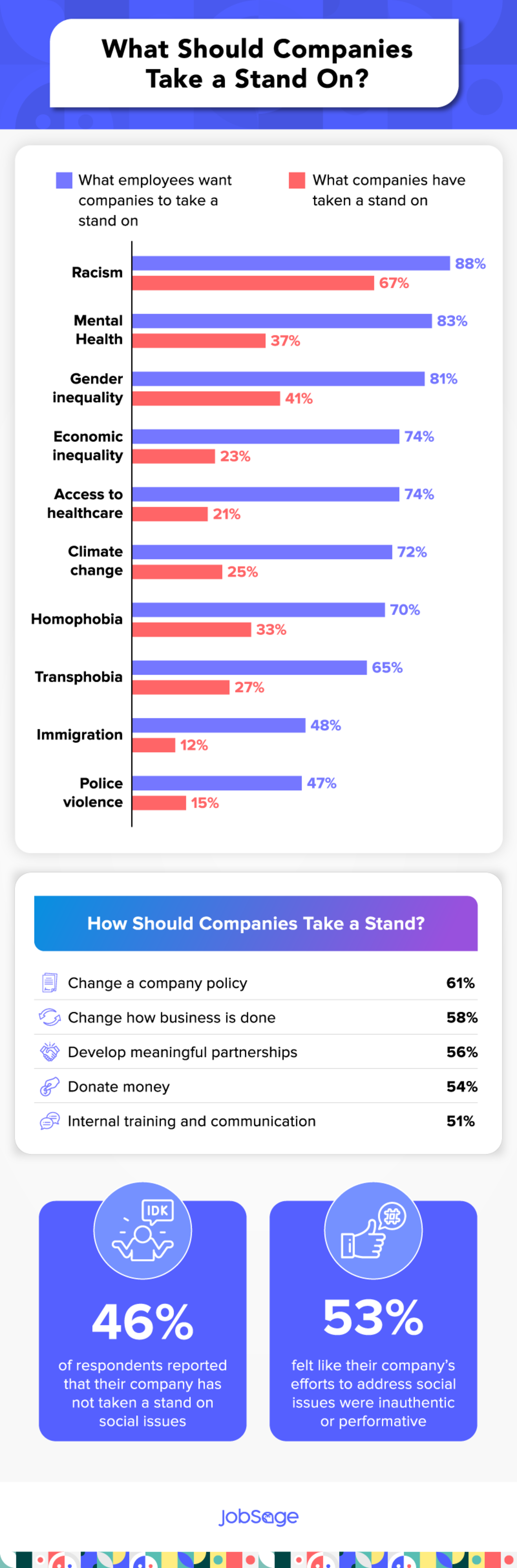
According to the survey, the top three issues that employees want to see their companies speak out about are racism (88%), mental health (83%) and gender inequality (81%). However, the percentage of companies that are actually taking stances on these issues is much lower — 67%, 37% and 41%, respectively.

The numbers are a good reminder that speaking out about social issues doesn’t have to land your organization in hot water or stir up controversy; advocating for mental health awareness, fighting racism and promoting gender equality are all relatively non-controversial moves that can make a big difference to existing employees and potential new hires.
And, according to the research, there are several ways that organizations – especially communicators — can make good-faith efforts toward showing employees they’re willing to take a stand.
More than half of respondents said they’d like to see companies implement internal training and communication as a way to demonstrate their commitment to a stance on social issues. This could mean anything from hosting lunch-and-learns about particular topics to inviting a guest speaker from a marginalized community, in addition to sensitivity trainings.
Letting your employees guide your efforts to take a stand on a particular issue is a good way to do so without coming across as inauthentic or performative. Take Taco Bell’s recent support of the LGBTQ+ community with its drag brunch promotion, spearheaded by members of the company’s LGBTQ+ employee research group. Provide your ERGs with the time and resources necessary to create initiatives and educate their colleagues about a certain topic, and you may see employee satisfaction and engagement rise. Those activities can also be used for employer branding.
As the workforce becomes younger and more diverse, remember that catering to your employees means more than talking about taking a stand — it’s worth taking the time create an actionable strategy showing employees that your organization cares about issues that are important to them.