

Member Exclusive: How REI fosters dialogue between hourly workers and leadership
The outdoor retailer launched the Compass Group to reimagine the employee experience for employees on the frontline.
By Justin Joffe, editorial director and editor-in-chief, Ragan Communications
Communicating change across business lines and audience segments is a delicate process, especially when it includes frontline employees.
Outdoor retailer REI Co-op understood this in 2022 when it developed the Compass Group as part of its larger “The Way Forward” initative. The Compass Group is an employee advocacy program designed to help the co-op reimagine the employee experience for workers in the field and give hourly field employees a stronger voice in shaping their experience at REI.
Rachel Lum, director of the Co-op Compass Group, helps the organization determine the most important employee experience topics by gathering employee input and co-creating solutions with hourly frontline employees. “I think of my role as a translator, taking strategic initiatives and breaking them down so any employee can understand it well enough to contribute from their perspective, using their lived experience,” Lum said.
“The Compass Group is designed with one outcome in mind: Allowing hourly employees to feel that change is happening in collaboration with and because of their inputs,” Lum explained. “This program helps us make changes with employees by bringing them directly into solution brainstorming and because of employee feedback.”
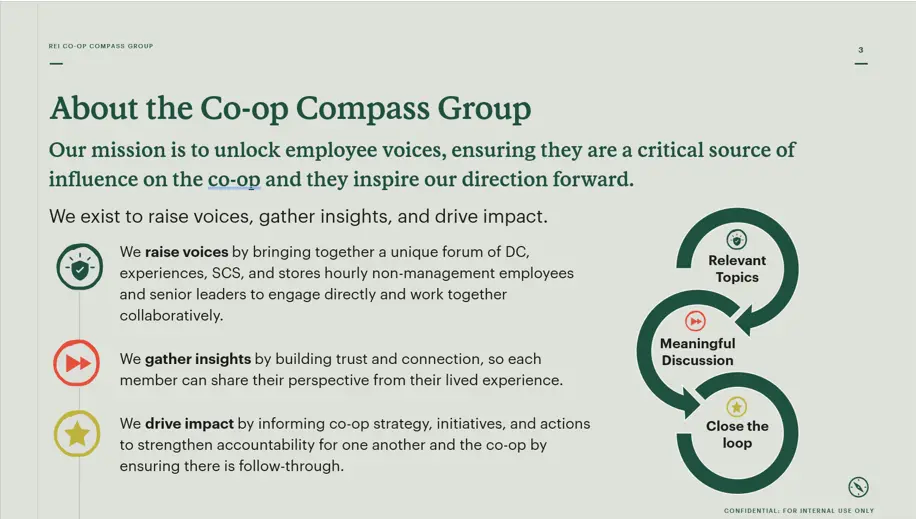
Applications for the inaugural Compass Group opened in June 2022, with over 250 employees applying. Applicants were announced that August, gathering virtually for a meet and greet before meeting in person that September at the REI satellite office in Issaquah, Washington. The Compass Group is made up of 24 employees and seven senior leaders who reflect the employee population and functions across REI. Hourly non-management employee Compass members come from stores, distribution centers (DC), sales and customer service (SCS), and experience teams. The committee selected members across region, role, tenure, race, gender and identity.
The guiding principles
Lum credits part of The Compass Group’s success to its focus on co-design and co-creation.
“My job is to set the stage to allow for co-design which leads to co-creation," she said. "Employees need to feel supported, so they can give us the honest and vulnerable feedback we need to get to where we want to go.”
This philosophy is embedded throughout the Compass Group’s core guiding principles:
- No individual speaks for an entire community. “We do everything in our power to bring diverse voices to the table across multiple forms of identity and inclusive of underrepresented communities,” says REI.
- Trust is the foundation. “We believe with strong relationships and trust, every member’s voice can carry equal weight. So, we acknowledge the dynamics of our diverse forum and use an equity-centered approach to design our discussion.”
- Center on employee experience and lived experience. “We value the unique perspective of our hourly employee members and select topics that tap into their expertise and lived experience.”
- Cooperatively design outcomes. “We discuss topics that can adapt and shift, rather than reactive to fully or mostly formed ideas. We have business partners at our discussions because their expertise helps us co-create realistic and applicable insights.”
- Share success and accountability. “All Compass Group participants are accountable for our four measures of success. We ensure responsibilities and decision rights are clear to support Compass Group members, business partners, and the program office be(ing) accountable.”
- Commit to action. “We identify topics that have clear pathways for consideration and follow through, so business partners can act following the discussion. We track follow-through to ensure action happens.”
- Meet the need. “We adjust our process to fit the needs of Compass members, the moment, and the topic. We remain flexible to support the best outcomes.”
- Clear, credible and transparent. “We will communicate and create content that has a purpose, shares our successes as much as our failures and keeps the voice of our employees at the center. Our communciations will be accessible to everyone, only adjusted for the audience and deliver methods.”
- Relevant topics. “We prioritize topics that center on the challenges that impact the day-to-day lived experiences of our employees, ensuring we discuss them at the right time for the most influence.”
Meeting and collaborating with business partners
The Compass Group partners with the communications team, which also takes a human-centered approach to its work.
“The key consideration is always thinking about the audience, which is similar to the concept of personas in human-centered design,” Lum said. “Communicators must start any work by asking themselves ‘Who is this communication for? What do they need to hear at this moment? What action do we want them to take?’ Centering the audience is key for any effective communication.”
Each meeting topic has a specific business partner, such as the HQ team, field operations team or even a group of leaders within the org, that owns the work associated with the topic and drives impact. When the Compass Group discussed development paths, the Talent Management team from HR was brought on as a business partner because it owns learning and development.
“Our business partners are responsible for considering Compass member insights in their design making,” explains REI. “They ensure follow-through on the work and their commitments to the Compass Group and the whole co-op.”
While these business partners would be doing the same work regardless, having the Compass Group as a resource to share insights helps makes their work better.
Here’s how business partners engage with a topic before, during and after each Compass Group meeting:
- Before the meeting, the business partner prepares Compass Group members by creating materials to brief Compass members on what they need to know.
- During the meeting, the business partner is expected to participate, communicate and listen.
- After the meeting, the business partner is responsible for considering Compass Group member insights in their work.
“Just like the best trails, we know our path to success won’t be a straight line,” REI says. “Along the way, we will work collaborative to ensure the voices of our field employees are influential.”
How it’s going
Two years into the initiative, Lum reflects fondly on the 25 organizational changes REI implemented due to the feedback of Compass members.
“This means that the insights we’ve gathered caused us to add, remove, or alter our approach to an existing program, policy or project,” she said. “That’s huge."
“The impacts of these changes are real, and have positively influenced the work of teams across the co-op. It’s helping us build momentum and expand our reach as the program matures. We know there is enthusiasm, and we believe it will only continue to grow as we continue to deliver meaningful results for our hourly employees.”
Join REI Sr. Manager of Communciations Nicole Bernard at Ragan’s Employee Experience Conference in Nashville, when she’ll share more about how internal communications partnered with the Compass Group to navigate a news platform launch, layoffs and other change messages with employees.