

Member Exclusive: 7 ways to get employees through a downsizing
By Justin Joffe, editorial director and editor-in-chief, Ragan Communications
~
Over the past few weeks, we’ve heard a lot about the central role that empathy, transparency and leadership play during layoffs. Empowering leaders to communicate mindfully with those who remain can reduce the attrition and loss of productivity that’s common after layoffs.
“You have to be human first and think about your values,” Karen Testa, director of global communications at Bell, told the CLC last week. “One of our values is that we lift each other up. That means we are committed and unified, always considering how our actions impact each other and align with what’s best for the company. It’s important to communicate openly and be transparent, even when it’s not a fun topic—that’s part of what we expect you to do as a leader.”
How can cascading such messages down serve as a calming force for both leaders and the employees who rely on them? Ragan and Communications Leadership Council members have a few ideas.
- Keep your cascade process consistent.
While announcing layoffs in waves is never a best practice, some workforce structures demand it. Bell, for example, employs both union and non-union employees. Similarly, a company that’s just been acquired may have several unknowns around the timeline and scope of its layoffs as M&As tend to be a drawn-out process with many moving pieces.
In such moments of uncertainty, establishing a consistent process and cadence for the flow of messages and next steps provides employees with stability and clarity—even when you don’t have good news or even all the news.
During this month’s member call, REI Divisional VP of Communications, Community and Inclusion Halley Knigge shared highlights from the people leader training her team launched this year, with an emphasis on refining the comms cascade. It begins with an intake process (Figure 1). Team leaders digest the news before curating the relevant bits for their teams.
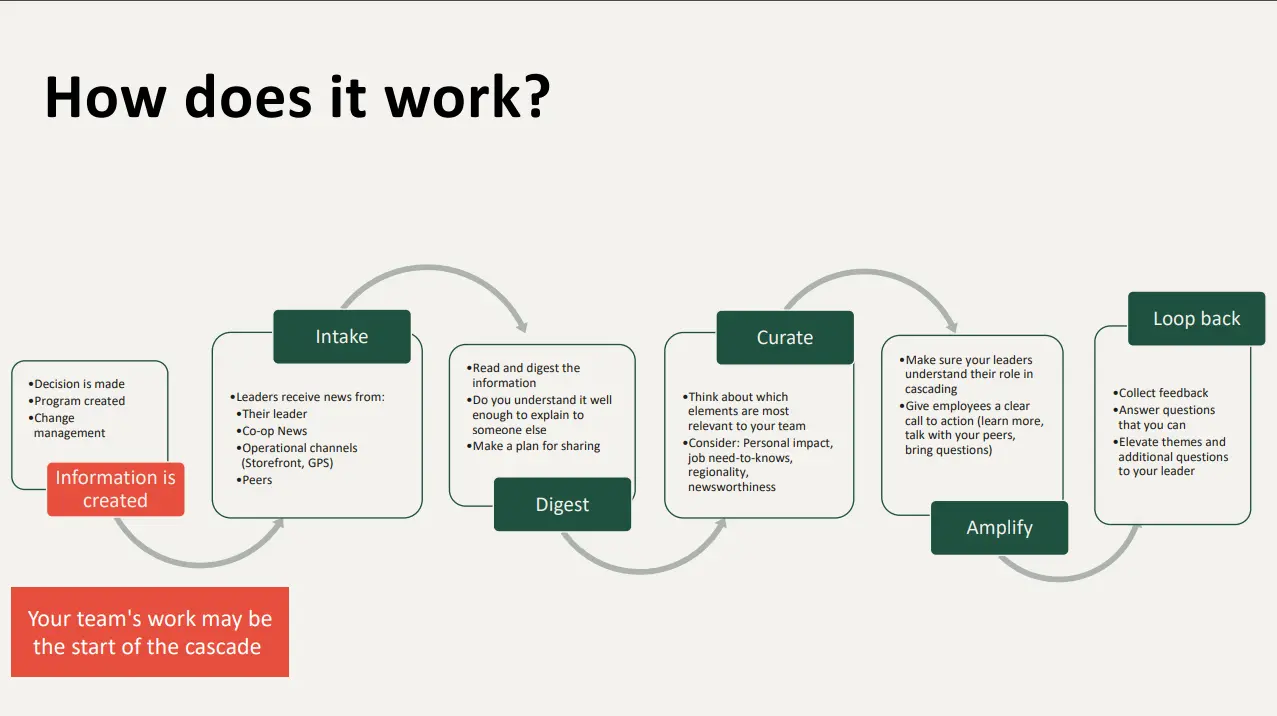
REI urges people leaders to consider the personal impact of the news and identify job-based need-to-knows. They should also give employees a clear call to action for the next steps, answer questions, collect feedback, and bring what they learn back up the cascade
2. Leverage leaders.
The cascade of layoff comms often begins with a message from the organization’s CEO for good reason. Executive communication at the outset of a layoff announcement demonstrates transparency and builds trust. The leader can deliver their first message at a town hall or all-hands meeting immediately before releasing a statement on your owned channels, like a brand newsroom page.This ensures those directly affected hear it first, while maintaining control of the narrative for external stakeholders. The messages should recognize and show appreciation for the work of those who have left the organization, and those who remain.
Well-prepared leaders who deliver layoff news with empathy and vulnerability demonstrate how your mission, vision and values are not just words on a wall. This soothes employee concerns by connecting themback to the organization’s sense of purpose, as PR Daily Editor-in-Chief Allison Carter points out, and also boosts your employer brand for current and prospective employees.
3. Reinforce resilience and adaptability.
Attrition happens after a layoff because the talent vacuum creates ambiguity or makes more work for those who remain.
Communicators can help leaders foster resilience and guide their teams through periods of uncertainty by encouraging managers to ask questions such as:
- How are you feeling about your current workload and your ability to meet deadlines?
- What’s changed, or what do you anticipate to change, workload-wise since the departure of our colleagues?
- Are there skill or knowledge areas where you would benefit from training or support?
- What tools and technology could help this team feel better equipped tohandle the departures ?
- Are there organizational obstacles created by this turnover that will keep you from doing your best work?
- What can we do as a team to support each other and maintain morale?
- Is there anything that I can help take off your plate?
- How else can I support you?
4. Remind those remaining of their resources.
Asking questions sends a signal that leaders are looking out for employees. It also collects qualitative intel for comms and HR about how they can better customize communications about the resources available to employees.
Support takes many forms, including reminders about counseling services and wellness benefits, career coaching or training modules, and mentorship opportunities.
Beyond reminders about counseling and your employee assistance program (EAP), managers should also reinforce any flexible working policies . This fosters psychological safety and reinforces your organization’s commitment to work-life balance. Remind managers to encourage breaks, vacation time and any custom policies on a case-by-case basis.
5. Facilitate feedback.
While prompts and guidelines to collect employee feedback is always a great move, it’s important to share it holistically, not surgically (as in an HR-mandated form with a deadline) to ensure it won’t be received as cold or ill-timed. Here, too, comms can equip managers with guided questions for one-on-one conversations with employees about the way layoffs were conducted and communicated. They can ask use questions like:
- Are you feeling supported and valued by the organization during this time?
- How do you feel about [ileader’s name]’s messages? Did you feel they, I and other leaders, had your back?
- Did the reasons given for the layoffs make sense? Were they well explained in the broader context of the business?
- Do you have a grasp on how these layoffs will impact our goals, strategy and future plans?
- Did you feel that enough information was provided around how these changes would impact our team and wider org structure?
- Were there enough opportunities to ask questions and have them answered in a reasonable timeframe?
- Do you have suggestions for how this news could have been delivered with more tact and sensitivity?
- Are there any channels or formats you would have preferred during this process?
- What additional support or information are you missing?
6. Activate and amplify an employee alumni network.
An employee alumni network can provide resources and potential opportunities for employees who were let go —even offering them the chance to boomerang back if conditions improve.
In Oct. 2022, CLC member Citi shared how it launched and grew The Citi Alumni Network to keep an ongoing relationship with former employees, equip alumni as brand ambassadors, , and ultimately bolster the bank’s recruitment pipeline by encouraging high-quality candidate referrals and rehires.
While such a service may be of greater interest to those leaving the company on good terms, its existence also sends a signal to current employees that the organization values the skillsets of its former employees and can keep the door open for the right candidate.
Adding such an effort to your offboarding benefits ensures that re-hires will be high quality and perform better, but also sends a signal to current workers that they can leave and the door will still be open.
It sets up a “not goodbye but see you later” situation.
7. Take care of your team — and yourself.
Last, and most importantly, ensure you and your communications colleagues are applying the aforementioned advice and support to yourselves.
Writing and edits for other departments are sometimes shifted onto the team with unreasonable or unsustainable turnaround expectations. The reprioritization period around layoffs offers a chance to set boundaries with other teams without coming across as negative or defensive. It can be as simple as taking time to teach them how you do something for them and setting the expectation that they will do it themselves from now on.
Keeping project management tools like shared content calendars updated will also empower you to more readily shift priorities around to meet the urgency of the moment and minimize the likelihood of your team feeling overwhelmed.
It’s also worth creating redundancies on your team so that one team member isn’t the sole communicator able to fulfill a deliverable or meet a deadline. That gives your team the flexibility to reallocate workloads should someone be at risk of burning out or need to take a day off.
Like most self-improvement measures, crafting calming comms starts from within. Your ability to take care of yourself and your team ensures you will be able to help take care of others across the organization.