

Member Resource: Mayo Clinic's guidelines for managing heated internal discussions
Develop clear and transparent guidelines for how you'll handle internal discussions before the heat gets turned up.
By Mike Prokopeak, director of learning and council content
When war broke out in the Middle East in October 2023, it sparked a range of strong and passionate opinions among employees in organizations across the world. Mayo Clinic was no exception.
It’s not unexpected that there would be variety of viewpoints in a large organization. But the situation at the healthcare provider, which employs 78,000 staff in offices, hospitals and home locations across several states, was complicated by the recent transition from Microsoft's Yammer to Viva Engage as the internal social platform of choice.
Topics like the war in the Middle East create challenges even when the rules of the road are well established. But Viva Engage, with the ability it gives employees to broadcast across the enterprise, made it especially challenging. “It was really a little bit like the Wild West in terms of what you can post,” said Annie Burt, Mayo vice chair, communications.
Viva Engage is designed for collaboration, belonging and sharing about your whole self, Burt said, and users are encouraged to talk about things that matter to them, including non-work content. When that freedom to post and respond makes others feel unsafe is where the challenge arises for communications teams.
“This informal place of collaborating and belonging needs to have some more structure to it that connects to our overall policies,” Burt said.
Establishing content guidelines
The issue isn’t limited to the Middle East. Comms leaders saw an uptick in the number of inflammatory posts on Viva Engage, mostly related to diversity, that pushed the boundaries of Mayo Clinic’s mutual respect policies, Burt said.
Those posts numbered only about a half dozen, but they got the attention of leaders and made the comms team realize they needed stronger guidelines to address them.
“There were some on face value who asked if we should just shut this whole thing down but I think when they saw the balance of pros and cons, they recognized this isn’t a platform problem,” Burt said. “This is a people issue.”
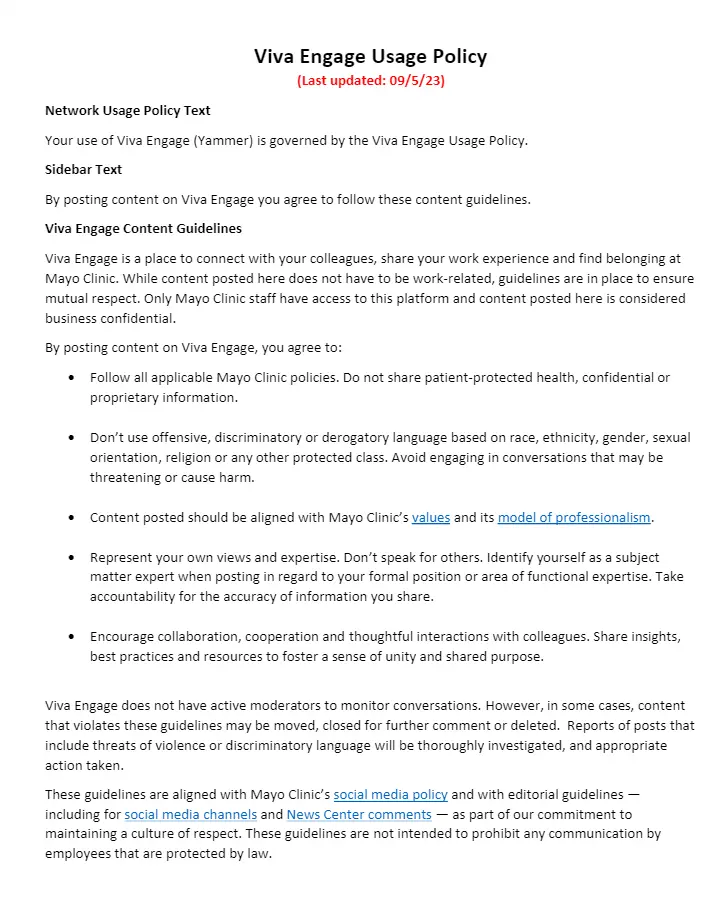
Mayo launched a set of content guidelines (below and linked here) when they did the formal cutover from Yammer to Viva Engage in 2023.
“They're very simple and easily understood by anybody, and they are very consistent with how we approach content generally speaking internally,” Burt said.
Tactics to support the guidelines
Of course, guidelines aren’t enough to solve the issue of divisive and discriminatory rhetoric on internal communications platforms.
Unlike other more formal channels, such as the clinic's publications and news center, there’s no one moderating discussions full time on Engage, so Mayo deployed a set of tactics to monitor content.
Mayo uses keyword triggers that send an automatic notice so the reputational risk team can review and make sure there's nothing that violates Mayo’s mutual respect or other policies. With elections in the U.S. this year, they may add presidential candidate names and hot-button political issues to the list.
CLC Resource: Election Issues Toolkit
“A soft touch at the beginning is helpful, but from there we have an escalation process where we have criteria that allows us to move a post into a topical channel,” Burt said. “So if we're talking in the main page about this thing that only concerns a few people and is really getting people wound up, we can move it to a more appropriate space.”
They’ve also opted to turn comments off on certain posts. “We've done that with some of the Middle East posts where we're no longer having a productive conversation," Burt said. “So we've just said comments on this post are closed, but the post stays up.”
In cases where they determine there is a policy violation or someone's physical or psychological safety is jeopardized, they have criteria to follow to delete a post.
“That's really been helpful as we've gone through the last several months and we've seen a couple more of these where we have a pathway, we know what to do, what to assess what our options are," Burt said. "We are notified early and then we can take the actions we need.”
Lessons learned
It's not all smooth sailing and as election season kicks into higher gear, communicators can expect to see more heated discussions break out in the workplace. Burt offered up this advice:
Leverage existing policies and procedures. In other words, don’t reinvent the wheel. “As a communications person I’m not trying to rewrite our mutual respect policy," Burt said. "We know with a lot of certainty what it means to be a Mayo Clinic employee and the kind of employer that we want to be for our staff.”
Direct issues that arise to the HR channels that already exist for handling them. “There are people that are trained and capable and ready to help them and work through those concerns," Burt said. "That’s important if you’re going to set up guidelines: Know where you’re sending people and try as much as you can to connect it to how your organization works today.”
Automate when possible but don't eliminate human oversight. Keyword triggers are a great way to monitor the discourse, but the technology can get glitchy so make sure you still have a person responsible for oversight and auditing content. Sometimes trouble can be brewing on the platform, but if the keywords aren't triggered everything will appear to be just fine.
Start with conversation then escalate if needed. Treat issues that emerge as an opportunity for dialogue. No one likes to be called out, Burt said.
“Approach the person with openness but clarity and leave a pathway for escalation. If you come in with, 'You violated our policies, you're banned,' where are you going to take that conversation if they have a negative reaction? So start with a conversation.”
Be transparent with expectations and actions you will take. “We expect all of our employees to follow these guidelines when they're interacting with each other and that includes on this platform. And communicate that if you don't, we may take these actions and here is why.”
Do you have a policy or guide you'd be willing to share? Send an email to [email protected].