

Member Resource: Microsoft's model for two-way leader communications
Led by CEO Satya Nadella, Microsoft has made a big shift in how the company approaches employee communications.
By Mike Prokopeak, director of learning and council content
Ten years ago, external communications drove the CEO's communications agenda at Microsoft, with press coverage and analyst reports taking center stage. Employee communications typically happened through one-way channels like email, newsletters and the annual company meeting, with employees playing the part of receiver of leadership messages.
That all started to change when Satya Nadella stepped into the CEO role in 2014. John Cirone, Microsoft senior director of global employee and executive communications, shared what the new approach looks like with CLC members at the Communications Leadership Council Spring Retreat in Santa Barbara, Calif.
Shifting leader communications to two-way conversations
Nadella made changing the company culture a major priority when he succeeded former CEO Steve Ballmer and became just the third person to lead the Redmond, Washington-based company after Ballmer and co-founder Bill Gates. A central pillar of Nadella's approach was to make internal communications a greater priority and lean into two-way conversations as a way to change culture.
Microsoft still uses communications channels like town halls and all-hands meetings, as well as email, Sharepoint, intranets and other tried-and-tested communications technologies. But the rollout of Teams marked a big shift for the company. Many newer employees never even go to their email to stay abreast of what's happening, Cirone said. That all happens in Teams, the company's collaboration platform.
Couple that with Nadella's emphasis on conversation and that pushed Cirone and his colleagues in the Global Employee and Executive Communications function to evolve the mix of channels (graphic below).
To enable more two-way conversations with employees, leaders are responsible for communicating via town halls and all-hands meetings. But they're also expected to participate in Ask Me Anything (AMA) events and post and engage with employees on Viva Engage, Micrsoft's proprietary internal platform. In addition, leaders post on LinkedIn where they are able to reach both internal and external audiences.
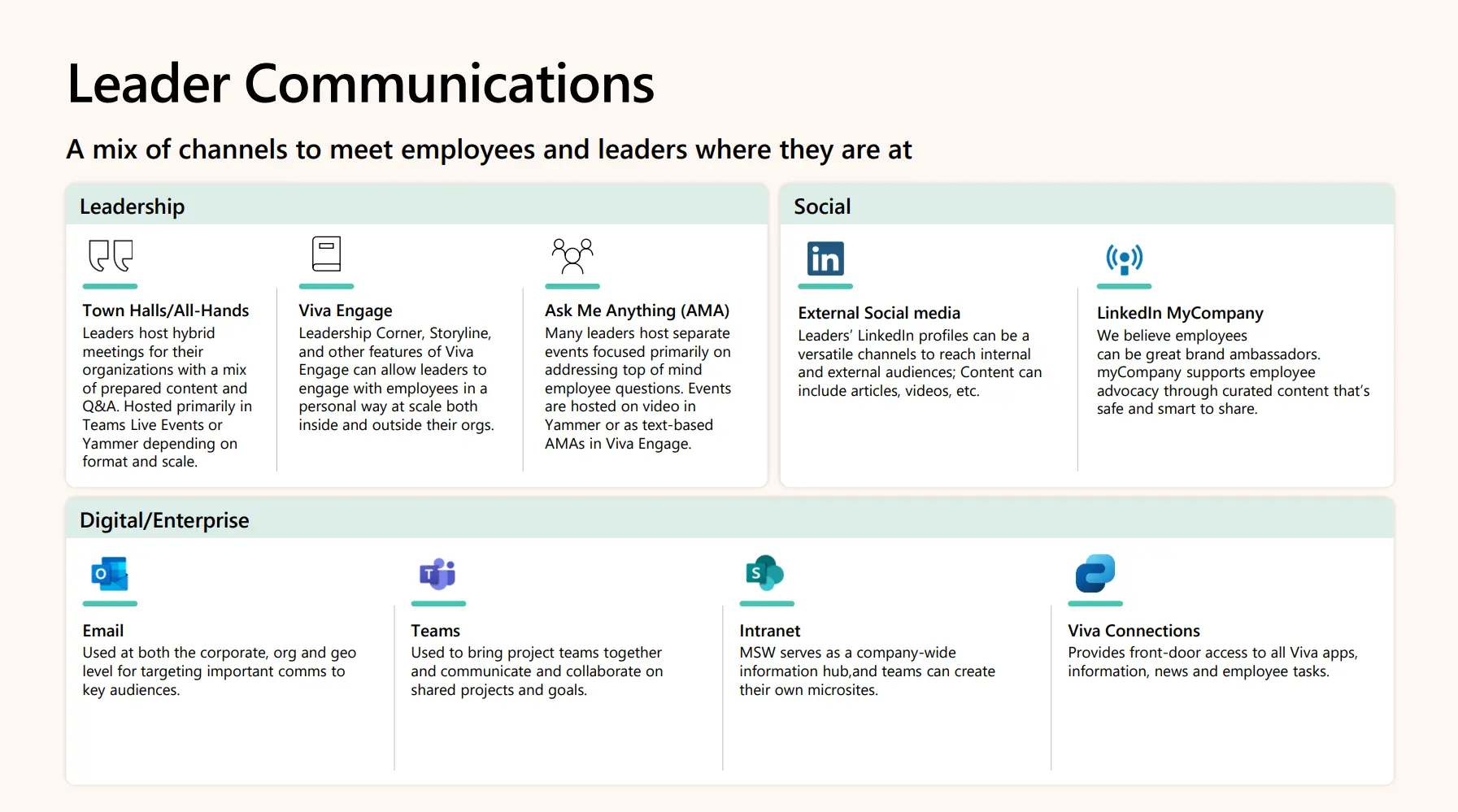
Viva Engage, and its Storyline feature, in particular have replaced email. Communities on the platform now provide a central place for shared conversations, files, events and updates, Cirone said. The comms team is also able to feature news events, celebrate DE&I moments and promote employee events there. Leaders are also able to use Engage to build their own internal profiles.
Engage is also great for CEO visibility, Cirone said, because the comms teams is able to share the events he participates in more broadly than they were able to in the past. For example, when Nadella took a trip to India he was able to deliver a town hall to Microsoft employees there that employees in Redmond would never have been able to see previously.
That more open, dialogue-based approach to communications carries through in other ways. According to Cirone, CEO communications happen through:
- Viva Engage
- Strategy Series: a version of a town hall where leaders answer questions live.
- External keynotes: Nadella's three keynotes per year are sent to employees as forced calendar holds and they’re encouraged to watch.
- All-hands meetings
- Social posts on LinkedIn and X
- All-company emails
The no. 1 driver of impact and satisfaction for CEO communications is employees' assessment of whether or not Nadella addresses the topics they care about in a timely fashion, Cirone said. That makes listening to their feedback and discerning signals from the noise critical.
Setting Up the Employee Listening Ecosystem
Microsoft's employee listening ecosytem includes two main approaches: push and monitor (graphic below).
Push listening includes tactics that actively seek out feedback and signals via a variety of methods including employee lifecycle surveys, feedback tools and a variety of engagement and pulse surveys.
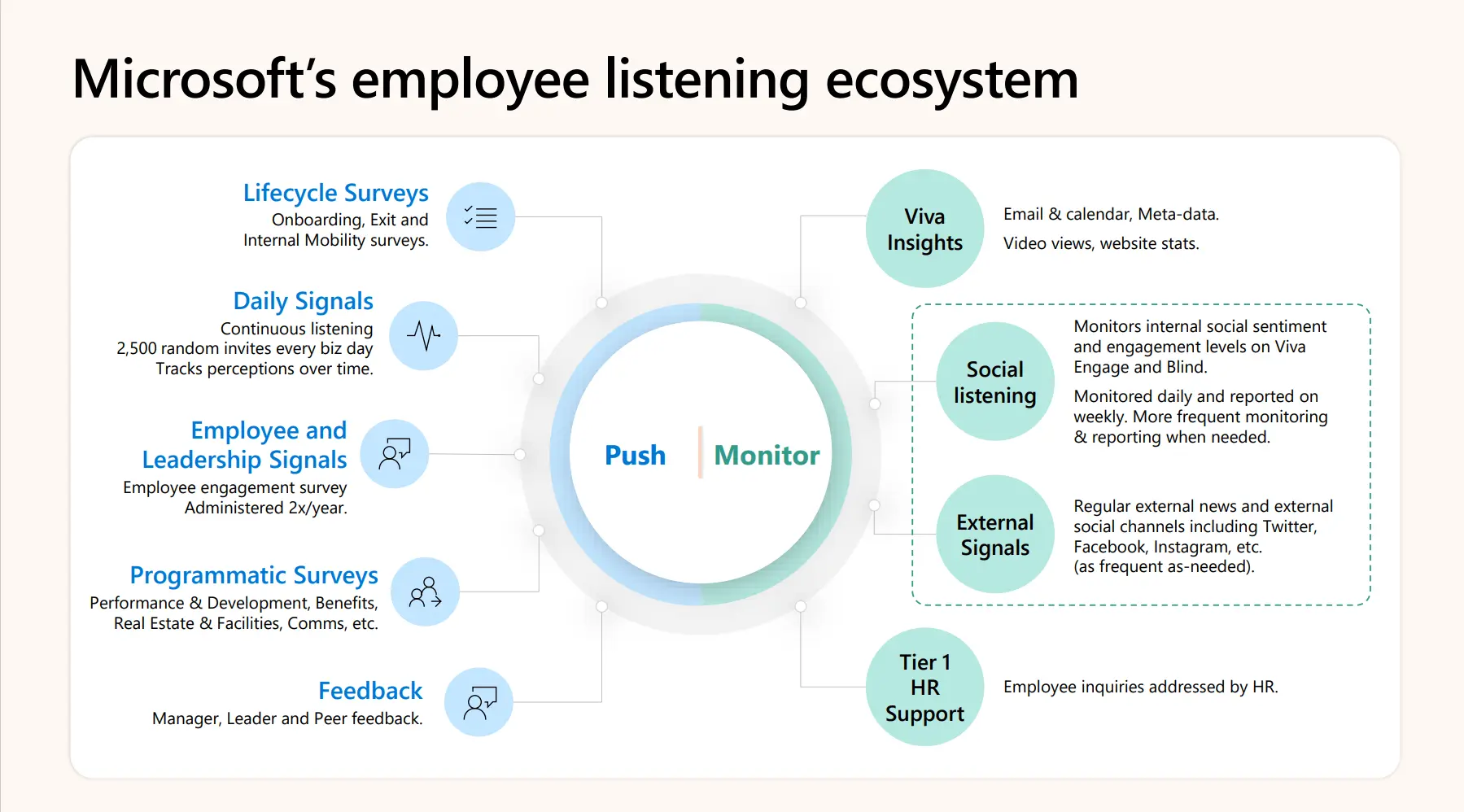
Monitor methods employ passive and ongoing listening tools, such as monitoring employee inquiries to HR, internal and external social listening, and meta-data collected through activity on Viva Engage.
Together, Microsoft's employee listening ecosystem and its evolving approach to leader communications represent the biggest change in Microsoft's employee communications since the 1990s, and have moved comms away from over-reliance on one-way channels like email and all-hands meetings to more open dialogues enabled by Viva Engage and interactive events like AMAs.