

Member Exclusive: Tips to build employee goodwill during union negotiations
CLC member Jason Lamers of BNSF railway shares his content strategy during bargaining talks
By Justin Joffe, editorial director and editor-in-chief, Ragan Communications
Last year saw several gains for the American labor movement, including a high-profile strike by Hollywood writers and actors and successful negotiations between UPS and the Teamsters union.
While the percentage of unionized workers remained relatively unchanged at 10%, according to the U.S. Bureau of Labor Statistics, the Economic Policy Institute reported that private sector unionization rose by more than a quarter million members last year.
New unions seem to be popping up often, from Wells Fargo workers forming the first union at a large U.S. consumer bank to California fast-food workers forming the first union of its kind in the industry. This is likely aided by the National Labor Relations Board (NLRB) passing modified legislation late last year that paved the way for unions to organize workers even if they lose elections. Earlier this month, the NLRB issued the first ruling of its kind to permit bargaining despite a union election loss.
Keeping up with evolving legislation remains the best way to ensure you arrive at conversations with general counsel and executives from a proactive, informed place. Reviewing the resources and reference guides published by the National Labor Relations Act (NLRA) doesn’t hurt either.
As the dot connectors, it’s on communciators to specifically adhere to legal requirements, parameters and guidelines that keep your messages compliant. Disseminating information through the union or the organization may require even closer work with government affairs, policy groups and local representatives than ever before.
CLC member Jason Lamers, the general director of internal communications and engagement at BNSF Railway, learned a lot about protecting brand and culture during labor negotiations. The railway is governed by the Railway Labor Act, which means they can’t have a strike that disrupts the nation’s rail network.
When it’s time for renewal, the collective bargaining agreement process involves negotiations with 12 unions. If there is a disagreement when it’s time to renew, the agreement stays in place until a new one is negotiated. This means that employees in those negotiations don’t see compensation improvement during the process, creating a new sense of urgency.
Lamers was frank when speaking to members last year about the challenges BSNF faced, which included historical supply chain challenges, competitive pressures, labor market challenges and an ongoing conversation about single-person crews.
Though the national bargaining was completed just over a year ago, those bargaining agreements end in 2024. The next round is set to begin in 2025 for the next five-year period. We caught up with Lamers to learn how he’s preparing for negotiations when they resume early next year.
“It’s very easy to be pulled into this ‘us against them’ mentality, but I try to think about how we rise above that and focus on the moveable middle,” said Lamers, who joined BNSF nine years ago. “There’s disengaged employees and engaged employees — how are we focusing on those folks who may be on the line or need help understanding?”
All content ladders back to the strategic pillars
When employees have a simple message, it can be tricky to provide the same level of attention when you’re legally bound by what you can and can’t share. But being silent is not an option
“It goes back to long-term strategy,” Lamers said. “It can’t just be a response to union bargaining right now, then going quiet for a while. It has to be sustained.”
BNSF’s broader content strategy focuses on these pillars:
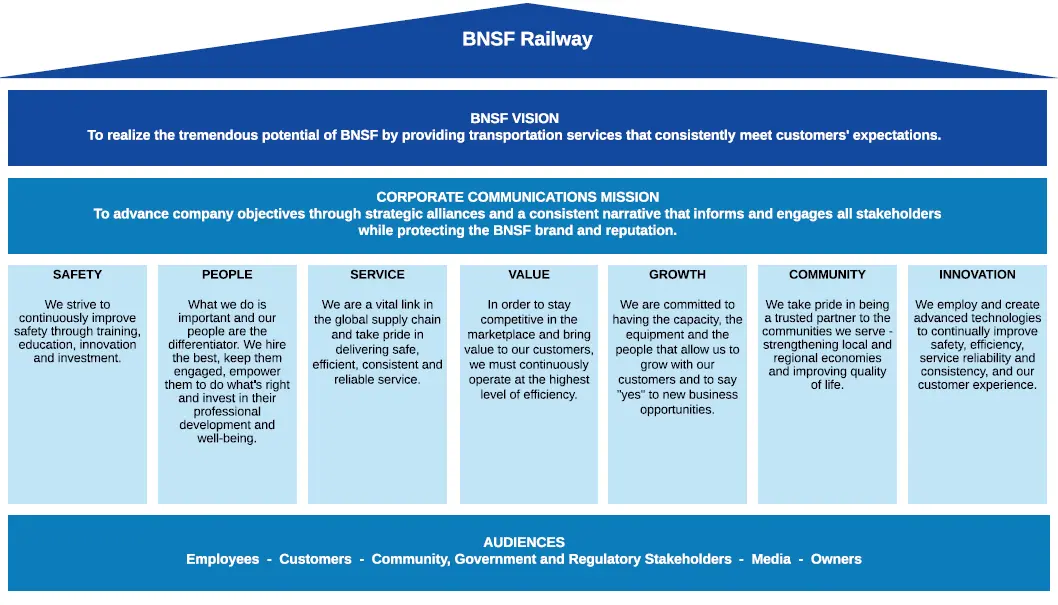
“In the past, the internal comms team at BNSF was mostly taking orders for content to be shared,” Lamers said. “Now we are creating our own content focused on a clear strategy to engage, build trust and create alignment. If HR has an announcement we need to get out, that’s still important, but our main focus are the pillars of our message house, and that's part of how you build a culture over time.”
While Lamers’ team fills content buckets across this message house, he places an outsized focus on the people bucket considering a majority of BNSF’s workforce is represented by unions. This is where he’s found employee stories are the best antidote to challenge toxic, often outright untrue, narratives that can arise during negotiations.
Platforming humanity
If BNSF hears a simple and sustained message from union leaders during the collective bargaining process, they are prepared to act on it. Lamers offered an example of hearing that members don’t have any time to spend with their families.
“That’s a message we all understand,” he said. “But, on the people side of our message house, we’re showing very clear examples of people going on camping trips, going hunting with their families or working on classic cars. We’re sharing pieces of content showing that’s clearly just not true.”
Spotlighting human faces and not just business performance content is a balance Lamers observes. Spotlighting employees doing great work in the community while talking about how much they love working for BNSF is key. That mindset shift began when the pandemic hit and the world changed.
“We’re still debriefing on the previous bargaining round and looking at what we can do to better educate employees and their families about the benefits they have with BNSF,” Lamers explained. This often means emphasizing leave, sick time and opportunities for them to be with their families.
Last week’s intranet front page featured a story about railroaders taking the podium at a Texas mountain bike event supporting their local cancer charity.
Another recent win included an article about a man who was retiring after 48 years at BNSF. His son still works for the railroad and saw it on the intranet main page after several people messaged him. The son then sent a thank you note to the comms team.
“Man, you can’t beat that,” Lamers said. “That’s golden—and we have to keep pounding out these authentic stories. We do care about them and their families, we do want them to enjoy life outside of work, and we need to show that’s actually happening instead of allowing negative culture that can swirl around at a local level.”
“That kind of stuff is really important to show, but you can’t fix it within a few weeks. That’s got to be years of continued work that builds trust over time.”
Navigating content reviews with consistency of tone and brand voice
Trust and empathy are paramount here, but it’s not always easy when dealing with legal and corporate stakeholders.
“It’s hard, even with the best intentions, to try and show empathy when you have to run articles or announcements past a long list of reviewers,” Lamers said, emphasizing a ‘control what you can control’ approach. “Messages can start to sound a little like the HAL 9000 robot. You’re never going to get out of the necessary reviews, nor would we, but you can take a little more control by having strong brand and tone governance.”
As BNSF continues to debrief on the previous bargaining round, better educating employees and their families about benefits is a huge opportunity. Many don’t realize what level of leave and sick time they have.
That said, labor agreements mean BNSF can’t just decide to change a policy based on feedback—things are worked out over time through the labor negotiation practice. Outside of the national bargaining round, communicating with union leadership through the lens of employee experience can fill in those gaps.
This requires better collaboration between the internal and external communications teams—something BNSF did not always consider.
“If you looked at the external comms versus internal, you might be confused by who's talking because there wasn’t a clear tone,” Lamers explained.
“Internal sounded formal, and external sounded more conversational. Thanks to an update to internal branding governance and tone, BNSF sounds more consistent across the different channels. This governance is key to helping get past the ‘lawyer speak’ or jargon that can be adding in the review process.”
Auditing your brand voice to look at simple things like technical writing and how contractions are used can make your comms sound more authentic and help build trust. Lamers is seeing leadership buy-in with this shift in brand voice.
“It was not a hard sell at all—everybody feels that and sees that. People see it as refreshing, and you can see it in some of the feedback we get on the content we’re sharing. They notice the difference.”
Fostering a two-way dialogue during bargaining
BNSF began making changes to comms during negotiation talks:
- Transforming AskBNSF. This service allows employees to ask questions, submit ideas and suggestions over email or via an intranet form. Repositioning it as an open comment feature helped. The open comment feature transformed “Ask BNSF” into a main feedback loop. “During these bargaining rounds, especially when things got really heated, AskBNSF was a solid weathervane to help us understand how employees were feeling or what rumors were out there,” said Lamers.
- Local town halls. “We do regular town hall meetings locally with our CEO and other leaders, and we’re able so share good information but also hear from employees and address rumors with facts.”
- Refining the deskless experience. BNSF Connect, an iPad-based app for field employees, proved helpful but posed some issues around balancing security with accessibility. Multi-factor authentication can hinder access for some. This was a part of BNSF’s migration to Simpplr’s intranet platform, which streamlines access by helping field employees use the intranet and app together instead of as two separate forums.
- Treating frontline supervisors as ambassadors. “As part of any internal comms strategy, frontline supervisors should be considered a channel for communication—so we’re asking ourselves how we can lean into that more,” said Lamers. “We know culture is often more local than not, and in many cases, that culture is created by those local supervisors in the field. How are we supporting those supervisors by giving them the tools and information they need to be a part of our content strategy, whether fighting rumors or helping people understand their benefits?”
Ultimately, Lamers is grateful for the employees who are already engaged and sees union comms strategy efforts as an exercise in keeping them that way.
“We want those who are on the line to understand how much our company supports them, cares about them and that we’re listening,” he said.